For many years I assigned Robert Putnam’s Bowling Alone in my Political Behavior class, and we had great discussions about the health of American civic life. In more recent years (I don’t assign the book anymore), I asked students to update some of the graphs in the book to see how the trends identified by Putnam continued into the 21st Century. One such graph (Figure 53) shows trends by generation in the percentage of people who report reading a newspaper every day. The original graph (with my scribbling) is below. The data come from the General Social Survey (GSS), which has asked this question regularly for over 50 years.
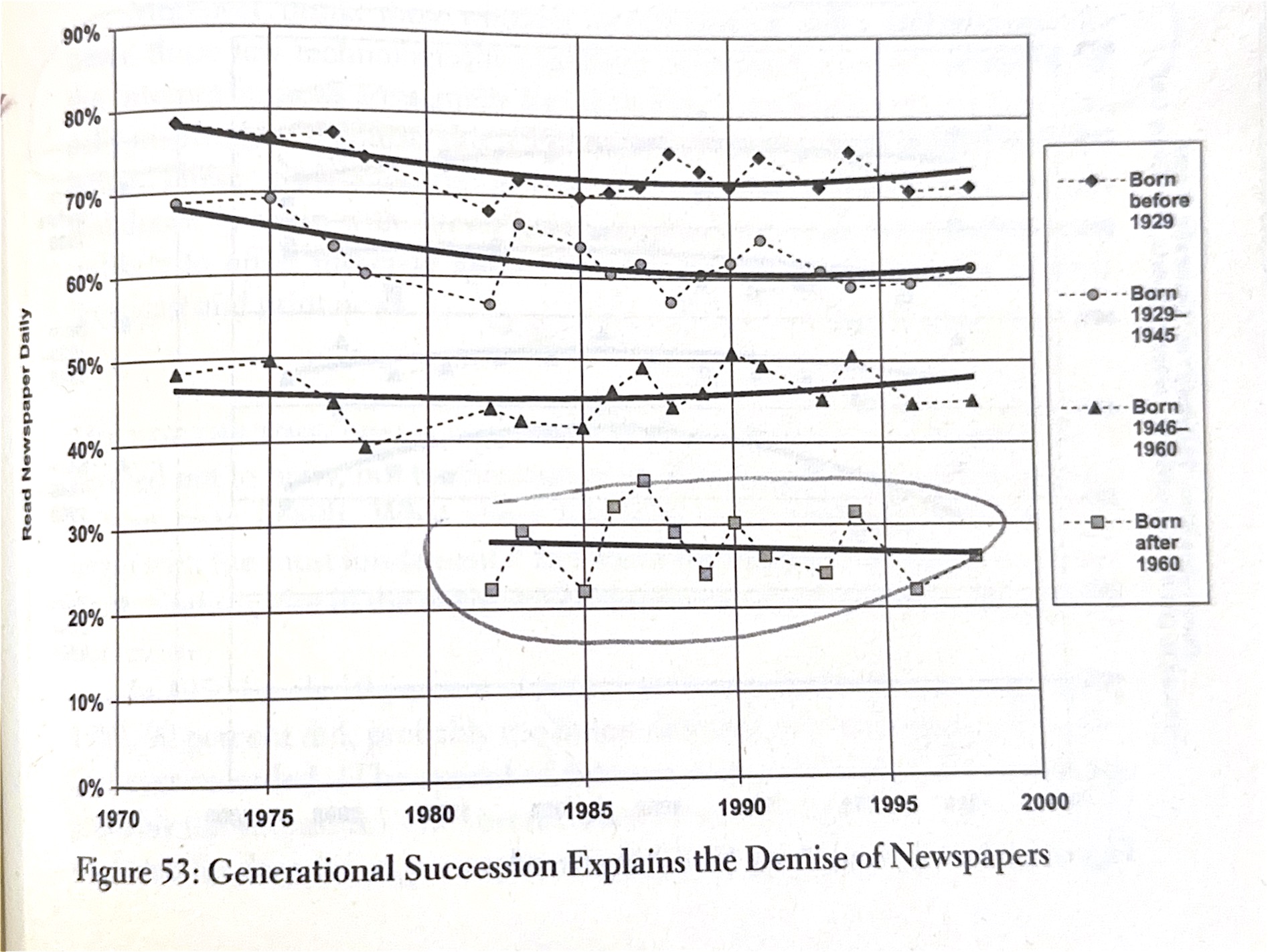
Putnam argues that life cycle effects are less at play in trends over time in contrast to stronger generational effects. That is, each successive generation reads the paper less often, but there was no decline within each generation between the 1970s and late 1990s. That’s a pretty interesting finding, I think. The obvious question is what has happened since 1998, especially with the decline of local newspapers and the spread of digital news?
I updated the trends for Figure 53 with data through 2024, using the GSS online. The results are below and point to declines within each generation over the last 25 years. Indeed, life cycle and generational effects are both at work in more recent decades. Those born after 1980 (millennials and younger Gen Zs) report very low rates of daily newspaper reading. Things have changed fast, indeed. In 2000, 60 percent of older Americans read the paper every day. Today (from the 2024 GSS), the share of the oldest cohort (those born between 1929 and 1945) that reports reading the paper daily is half what it was in 2000.
(It’s not clear to me how respondents interpret the question. It does not specifically ask about reading a print copy of the paper. So presumably loyal readers of a newspaper online would still count here, which makes these declines even more startling.)
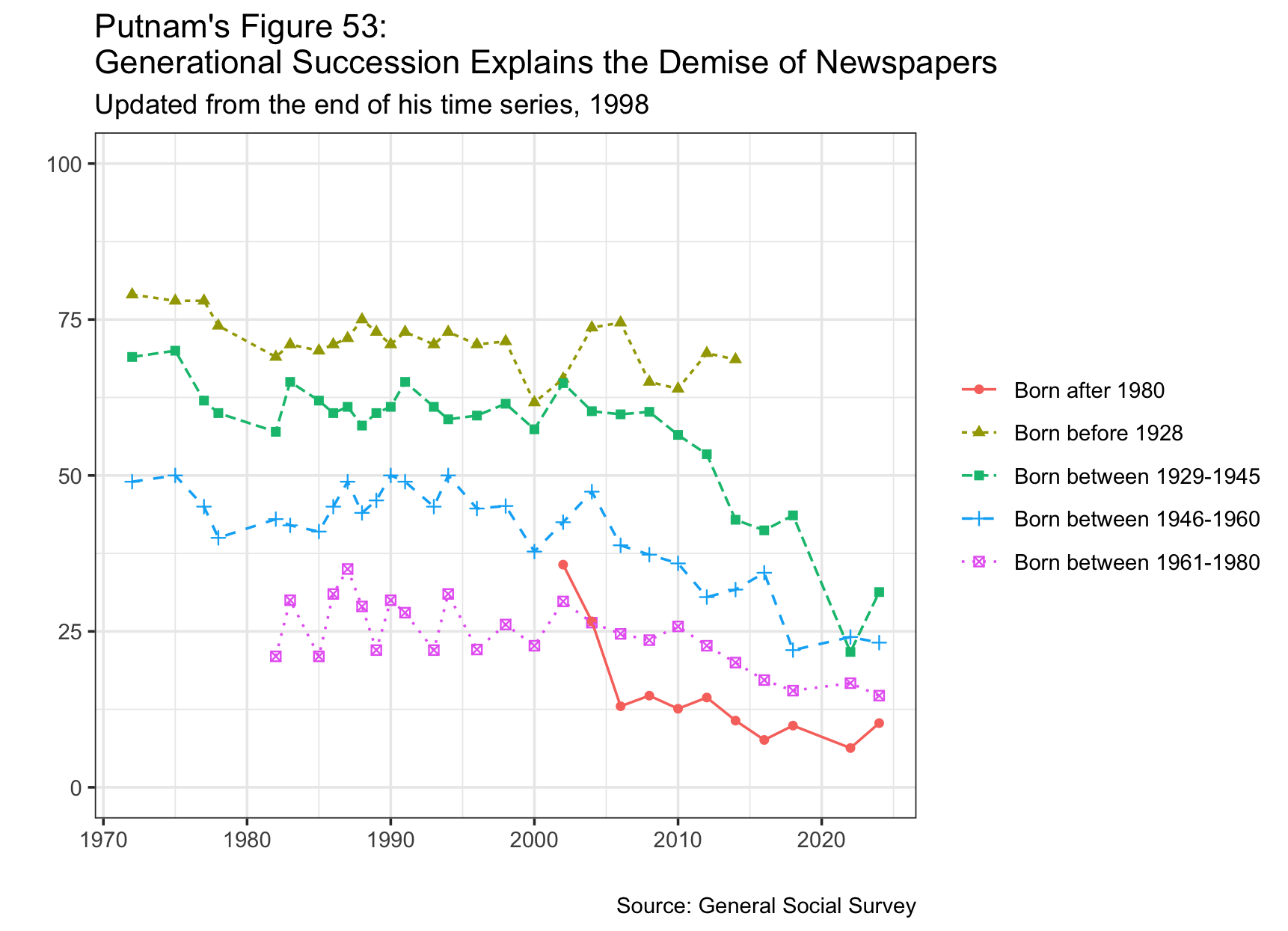
Of course, people still get plenty of news today, through social media, television, and newspapers’ websites. But the experience of reading a local or national paper every day is disappearing. This is a function of a loss of supply, for sure, as local newspapers die off; but it also seems a change in demand for traditional news, as Americans increasingly turn to social media.
 Michael Franz